Choose the Organization Before Falling in Love With the Destination
A beautiful destination cannot make a volunteer placement ethical. Meaningful work begins with a credible host organization, a locally defined need, appropriate skills, trained supervision, safeguarding, and enough time to contribute without creating extra burden. A traveler should therefore compare programs before scenery. Ask why an international volunteer is needed, who leads the project, how local workers are paid, what fees support, and what measurable work continues after visitors leave. Avoid short-term orphanage placements, unlicensed medical work, wildlife contact sold for photographs, and projects that promise transformation without explaining results. The destinations below can support responsible programs in conservation, trails, research, heritage, and skilled service, but every opportunity must be verified independently and against current safety, visa, health, and travel guidance.
A: No the individual organization and role still require verification.
A: The host should set a minimum based on training and useful contribution.
A: Yes when tasks are bounded supervised and part of a long-term plan.
A: Only with suitable qualifications curriculum support and continuity.
A: Only through trained coordinated organizations that request their skills.
A: Only with documented welfare veterinary oversight and no tourist contact.
A: Usually they are reciprocal work arrangements rather than community aid.
A: Use the support process and leave if consent safety or ethics fail.
A: Not when privacy research or safeguarding rules prohibit them.
A: Learning one place through accountable work rather than collecting dramatic moments.
Patagonia for Park and Trail Stewardship
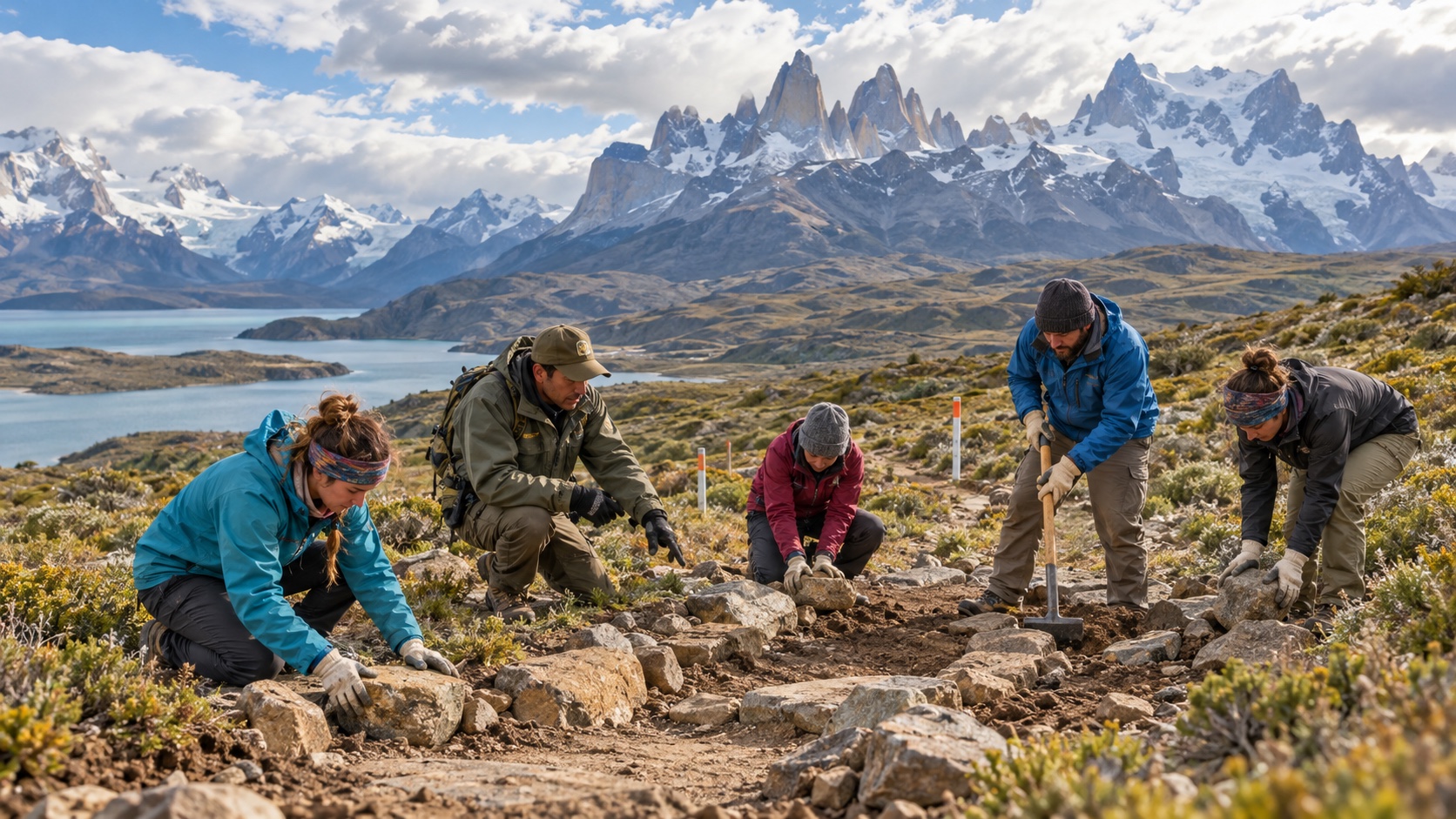
Chilean and Argentine Patagonia contain heavily visited parks, remote trails, strong winds, fragile soils, and communities managing seasonal tourism. Established park agencies and conservation groups may organize erosion repair, invasive-plant removal, campsite maintenance, monitoring, or visitor education. The project should have professional leaders, land authorization, safe tools, protective equipment, and a clear plan beyond the volunteer week.
Weather can cancel work without warning, while transport and medical access may be limited. Volunteers need realistic fitness, layered clothing, insurance, and flexibility. Trail construction affects drainage and habitat, so never improvise. Confirm whether the placement supplements paid crews rather than replacing them. Staying afterward in locally owned lodging can support the region without turning the worksite into a private attraction.
Trail volunteers also need to understand the conservation reason behind the design. Stone placement, drainage, switchbacks, and barriers control water and foot traffic, and a well-meaning shortcut can undo that work. Ask whether the program records repaired distance, erosion change, or maintenance needs rather than reporting only volunteer hours. Large groups should be divided into supervised crews so sensitive vegetation does not become an informal staging area.
Costa Rica for Permitted Turtle and Forest Research
Costa Rica hosts long-running conservation programs involving sea turtles, birds, amphibians, forests, and habitat corridors. Reputation alone is not evidence. A turtle project needs permits, trained research leadership, standardized protocols, controlled lighting, and strict limits on handling. A forest program should explain its research question, data system, and relationship with land managers. Expect night shifts, insects, humidity, rain, long walks, and repetitive records. Never choose a project that guarantees carrying hatchlings or holding wildlife. Ask how local scientists, students, and residents participate and how results affect management. Several weeks at one field station are generally more useful than moving among projects, and shared ground transportation can reduce unnecessary domestic travel.
New Zealand for Biosecurity and Habitat Restoration
New Zealand conservation programs may focus on island biosecurity, invasive species, native planting, trail maintenance, bird monitoring, or wetland restoration. Tasks must sit within an expert management plan because removing the wrong species or moving contaminated gear can damage vulnerable ecosystems. Agencies should provide identification training, safety equipment, permits, and measurable long-term objectives.
Clean footwear and tools before and after every site, follow track closures, and report rather than conceal mistakes. Remote islands may have scarce water, lodging, waste capacity, and medical support, so volunteer groups should not overwhelm local resources. Māori partnership and authority are essential where work involves Māori land, knowledge, or culturally significant species.
Greece for Marine and Coastal Monitoring
Greek islands and coastlines support sea turtle research, seagrass surveys, beach monitoring, marine-debris audits, and public education. Programs vary greatly. Confirm scientific permits, the local institution, data protocols, boat safety, accommodation, and how results are used. Water work requires honest swimming ability, appropriate certifications, and trained supervision.
Island housing, water, waste, and ferry capacity can be strained during high season. A responsible program limits group size and does not divert scarce rooms from residents without considering the effect.
Volunteers should not touch wildlife or coral outside authorized protocols. Shore-based data processing, outreach preparation, and equipment care may be more valuable than a photogenic day at sea.
Nepal for Skilled Trail and Heritage Programs
Nepal may offer placements connected to trail infrastructure, mapping, seismic engineering, cultural heritage, public health systems, or long-term community organizations. Mountain scenery can distract applicants from the central test: does the host need this specific expertise? Construction, engineering, clinical, and conservation tasks require proper credentials, authorization, local counterparts, and handover.
Altitude, monsoon conditions, road safety, earthquakes, and remote medical access affect placement planning. Short-term visitors should not teach or treat simply because standards appear different. Choose organizations that pay local professionals, provide language and cultural training, and define emergency procedures. A slower regional itinerary helps volunteers acclimatize and reduces pressure to begin demanding work immediately. Heritage roles require particular care with data and images. Structural surveys, maps, photographs, and oral histories may reveal private, sacred, or vulnerable sites. The host must control storage, access, publication, and handover. Travelers should not upload project files to personal accounts or share dramatic damage photographs before the responsible institution approves release. Strong programs pair visiting skills with paid local expertise and training.
Namibia for Community Conservancy Support
Namibia’s community conservancies and desert environments can support roles in monitoring, mapping, communications, visitor systems, habitat restoration, or technical training. The conservancy itself should define the need and retain authority over data and decisions. Programs should explain governance, local compensation, land use, and how tourism or conservation revenue is distributed. Desert heat, long drives, water scarcity, and wildlife require serious risk management. Unskilled travelers should not join anti-poaching patrols or handle animals. Useful work may take place in an office, database, workshop, or community meeting rather than beside wildlife. Ask whether a local paid contractor would produce a stronger result before assuming an overseas volunteer is necessary.
Ecuador for Biodiversity Research With Local Institutions
Ecuador’s Andes, Amazon, coast, and islands support biodiversity studies, restoration, agriculture, and community tourism. Strong placements are linked to a recognized local university, reserve, nonprofit, or community organization. They identify permits, research methods, data ownership, language expectations, and the staff member responsible for supervision.
Avoid programs offering captive-animal selfies, contact with isolated communities, or vague jungle help. Amazon fieldwork requires health preparation, water safety, insect protection, and respect for Indigenous authority. In the Galápagos, biosecurity and protected-area rules are nonnegotiable. Travelers can often contribute more by remaining at one site and completing a consistent dataset than by visiting multiple ecosystems.
Research accommodation deserves the same scrutiny as field methods. Ask about drinking water, sanitation, food, power, communications, transport, separate sleeping arrangements, and procedures for harassment or conflict. Remote settings can make volunteers dependent on the provider, so the organization needs confidential support and a safe exit process. A beautiful field station does not excuse weak welfare, unclear fees, or inadequate supervision.
Scotland for Peatland and Path Restoration
Scotland offers conservation programs involving upland footpaths, peatland recovery, invasive plants, woodland, coast, and wildlife surveys. Regional access can make a short, bounded team project more practical for some travelers than an intercontinental placement. Established charities or land managers should provide technical plans, tools, weather gear lists, safety systems, and follow-up maintenance.
Peatlands store water and carbon but are easily damaged by poor foot placement and drainage. Volunteers must follow the site leader precisely and keep to durable work routes. Cold rain, wind, boggy ground, and midges can turn a simple task into a demanding day. Book local accommodation and transport without assuming a rural community can absorb a large group at short notice.
Japan for Rural Landscape and Cultural Heritage Work
Some Japanese nonprofits and local associations organize satoyama landscape care, forest maintenance, trail work, agricultural exchanges, disaster recovery, or heritage documentation. Language ability and cultural orientation may be essential, especially where tasks depend on local tools, group routines, or older residents’ knowledge. The host should distinguish volunteering from paid work and clarify visa rules. Do not treat farm labor or private homes as cultural access purchased through a fee. Ask about hours, insurance, machinery, accommodation, meals, and rest days. Heritage records and oral histories require consent and community control. A modest role completed reliably is preferable to a visitor proposing changes before understanding why the local system works as it does.
South Africa for Professional Skills Rather Than Wildlife Contact
South Africa has sophisticated universities, conservation organizations, health systems, museums, and social enterprises that may request research, legal, technology, finance, design, or monitoring skills. Applicants should avoid programs selling cub petting, predator walks, captive breeding contact, or unstructured access to children. Sanctuary and community labels need independent verification.
A professional assignment should define deliverables, supervision, data protection, liability, and the local colleague who will continue the work. Travel safety varies by location and should be assessed through current official advice and host procedures. Ethical programs can explain why the volunteer is useful without suggesting that local expertise is absent.
Canada and the United States for Regional Service Travel
Travelers often overlook domestic or nearby park crews, conservation corps, watershed groups, archaeological programs, disaster-recovery organizations, and citizen-science projects. Regional placements can reduce flight cost, simplify credentials, and allow a volunteer to return. Agencies and established nonprofits may offer clearly bounded tasks with trained leaders and transparent public goals.
Domestic does not mean risk-free. Wildfire smoke, heat, cold, wildlife, tools, boats, and remote terrain still require preparation. Respect Tribal and First Nations authority where projects involve Indigenous lands or knowledge. A nearby placement may deliver more useful hours and stronger follow-up than a distant program chosen mainly for its scenery.
Applicants should compare the total cost of participation with alternative support. Flights, fees, insurance, equipment, vaccinations, and staff supervision may exceed the value of short unskilled labor. That does not automatically make travel wrong, but the in-person role needs a clear reason. Sometimes a regional program, remote professional assignment, or direct grant will serve the host better and create a more honest relationship. Travel insurance must cover the work rather than only ordinary sightseeing. Trail tools, boats, diving, remote research, high altitude, farm machinery, or manual labor may fall outside a standard policy. Confirm medical evacuation, preexisting-condition rules, and the process for contacting assistance. The provider should maintain its own risk systems instead of presenting a participant’s personal policy as the entire emergency plan. Volunteers also need boundaries during free time. Do not use the host’s name to gain access to restricted communities, research locations, patients, wildlife, or staff homes. Independent tourism should follow the same photography, cultural, safety, and environmental standards as the placement. Off-duty conduct can still affect the local partner’s trust and reputation.
Let the Host Define What Unforgettable Means
The strongest destination is the one where the volunteer’s role makes sense after travel marketing is removed. Compare the host’s need, project history, local employment, supervision, safeguards, safety plan, fees, duration, data, and handover. Then consider whether your skills and availability genuinely fit. A responsible organization may recommend another role or reject the application. Keep tourism separate from protected work hours and never turn beneficiaries, patients, children, wildlife, or research sites into personal content. After returning, describe the limited contribution accurately and direct attention to the host’s continuing work. An unforgettable placement is not one that makes the visitor feel indispensable; it is one that teaches why accountable local leadership remains indispensable.