
Meaning Comes From Accountability Rather Than Intensity
A meaningful volunteer placement may involve quiet data entry, cleaning field equipment, maintaining a trail, reviewing documents, or repeating a survey correctly. It does not need dramatic photographs or daily contact with vulnerable people. The central question is whether the host organization genuinely needs the work and can supervise it without diverting more resources than the volunteer contributes. Travelers should match a real skill to a defined role, stay long enough to learn and hand over responsibly, and recognize when a donation or paid local position would be more useful. Before applying, examine safeguarding, background checks, insurance, risk management, local partners, fees, accommodations, visas, and emergency support. The program types below can create worthwhile travel, but only when local leadership and long-term purpose remain stronger than the visitor’s desire for a life-changing story.
A: The role should determine the minimum rather than the traveler’s vacation calendar.
A: Yes for bounded supervised tasks within a long-term plan.
A: Some programs train beginners for standardized work under qualified supervision.
A: Fees may cover real costs but a transparent itemized explanation is essential.
A: Frequent short relationships can harm children so choose non-contact roles.
A: Only within the same legal ethical and supervisory limits expected at home.
A: No responsible programs do not sell contact for photographs.
A: Only items the host explicitly requests and can use sustainably.
A: Raise it through the stated support process and leave if safety or ethics fail.
A: Report the host’s continuing work accurately without centering yourself.
Sea Turtle Monitoring With Authorized Researchers
Sea turtle programs may patrol nesting beaches, record tracks, protect marked areas, enter standardized data, manage visitor behavior, or support hatchery work where local authorities use it. The program must operate with permits and qualified leadership. Handling adults, eggs, or hatchlings should occur only when the approved protocol requires it and trained staff direct the task.
Night work, insects, heat, rain, long walks, and irregular sleep are common. Volunteers should understand why red light, silence, distance, and photography restrictions matter. Ask how data informs local management and how the project works with residents whose livelihoods intersect the beach. Avoid programs that guarantee releases or let every guest carry a hatchling for a photograph.
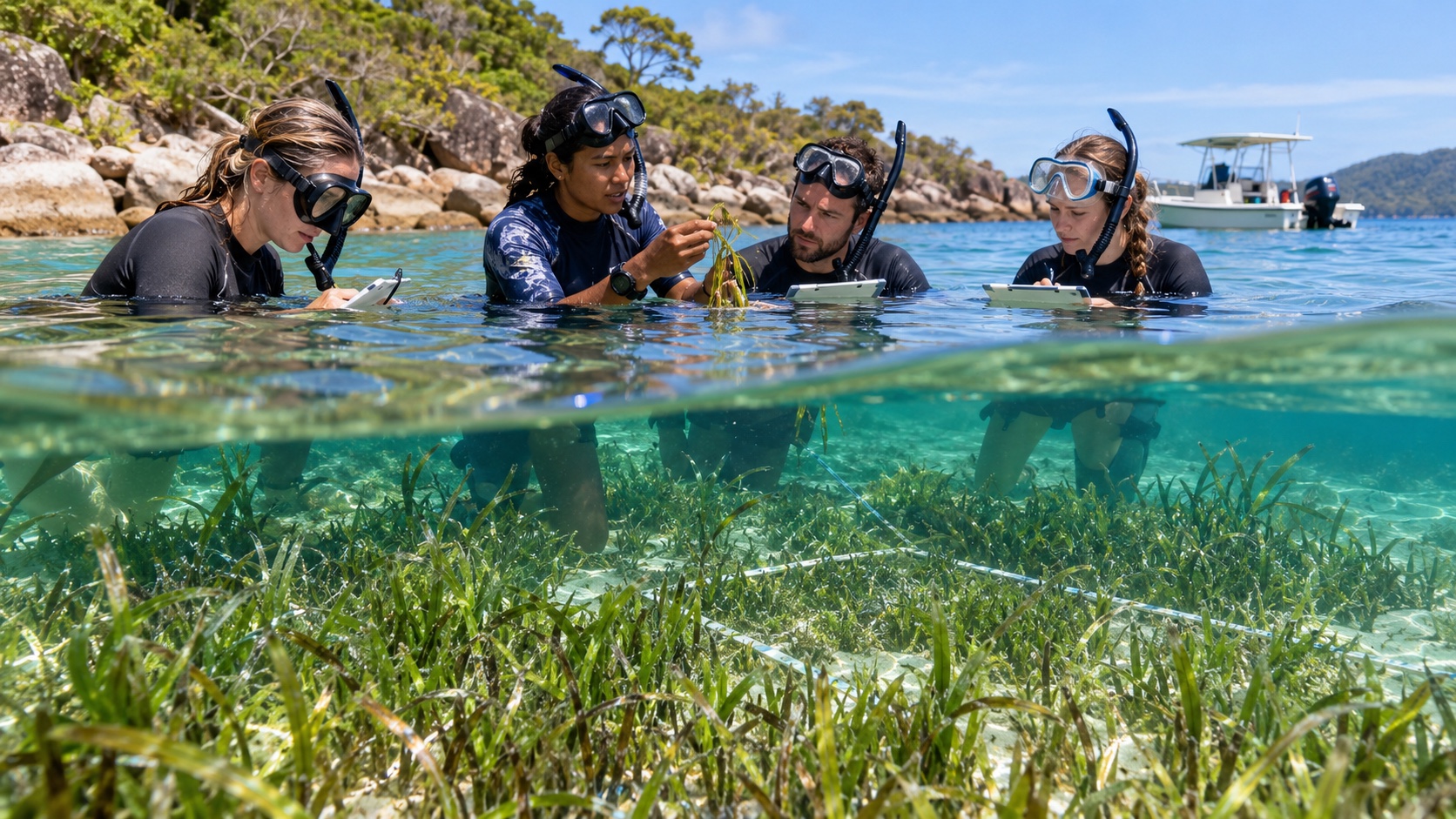
Seagrass and Coastal Survey Placements
Seagrass monitoring, shoreline mapping, water sampling, and marine-debris audits can produce useful repeated data when a scientific organization owns the protocol. A local marine biologist should determine sites, methods, frequency, quality control, and safety. Volunteers may spend as much time entering data, cleaning equipment, and checking records as they spend in clear water.
Swimming or diving roles require honest skill assessment, suitable certification, medical fitness, and supervision. The project should have permits and a plan for boats, fuel, wastewater, and equipment.
Never touch wildlife or remove material outside the protocol. Ask whether local students and researchers receive training or paid roles and how results reach managers or communities.
Island Biosecurity and Invasive Species Work
Island ecosystems can be highly vulnerable to introduced plants, animals, seeds, and pathogens. Volunteer teams may clean equipment, remove invasive vegetation, monitor traps, restore native habitat, or help maintain quarantine infrastructure. These roles are useful only within an expert management plan; removing the wrong organism or working at the wrong season can cause damage. Expect careful identification, repetitive procedures, sharp-tool rules, and strict cleaning between sites. Ask about herbicide use, protective equipment, disposal, and the evidence behind the control method. Travelers must follow customs and biosecurity rules before the project begins, including restrictions on food, soil, and outdoor gear. A credible program reports ecological outcomes rather than only volunteer hours. Island assignments may have limited housing, medical care, fresh water, and waste capacity. Volunteer groups should not consume scarce resources without a clear local benefit. Ask whether accommodations use existing capacity or displace residents, how supplies arrive, and what waste leaves the island. Cleaning boots after the work is as important as cleaning them before it. Volunteers should also understand that successful eradication or control work may involve difficult animal-welfare questions requiring trained staff and formal oversight.
Reforestation Projects With Survival Monitoring
Tree planting appeals to travelers because the action is visible, but meaningful restoration extends far beyond placing seedlings in soil. Site selection, land rights, native species, genetic diversity, water, seasonal timing, fire, grazing, maintenance, and survival monitoring determine whether the work lasts. The host organization should explain each element and identify who manages the land.
Volunteer teams can support nursery work, planting, mulching, measurements, or maintenance under local supervision.
Ask whether local workers are paid and whether the project has replaced natural grassland or another valuable habitat with inappropriate trees. Impact should be measured through survival and ecosystem recovery over several years, not a large one-day planting total.
Archaeological Field Schools Abroad
An archaeology field school combines structured education with supervised research. Students and volunteers may excavate, wash and label finds, draw features, enter records, survey landscapes, or help conserve materials. The project needs legal permits, professional direction, ethical collection policies, safe working conditions, and an identified institution responsible for artifacts and archives.
Ask how descendant or local communities participate and how results will be published or interpreted. No legitimate project allows participants to keep finds or buy antiquities. Expect meticulous measurement and paperwork rather than treasure hunting. Fees should separate tuition, accommodation, meals, transport, and research costs so applicants can judge value and access. Excavation is only one part of archaeology. Laboratory, cataloging, conservation, geographic information, and public interpretation roles may be more suitable for participants with limited mobility or field experience. Programs should not exaggerate inclusivity if housing, toilets, or work areas remain inaccessible. Ask specific questions and request photographs or measurements where needed. A well-run field school can explain its accommodations honestly and find useful work without placing a participant or the site at risk.
Heritage Documentation Under Community Control
Architectural surveys, oral-history transcription, language archives, cemetery records, and museum cataloging may benefit from volunteers with relevant training. Cultural information can be sensitive, so the community or institution must control what is recorded, where it is stored, who can access it, and what may be published. A signed consent form does not automatically make every story public. Roles should match skills in conservation, photography, audio, archives, translation, or data management. Volunteers need secure workflows and a clear handover. Do not upload material to personal cloud storage or social media. The best project strengthens a local archive or team rather than extracting a digital collection that becomes inaccessible to the people who created it.
Trail Crews in Mountain and Forest Regions
International trail crews can repair erosion, clear approved vegetation, improve drainage, maintain signs, or restore campsites. A park agency or established conservation organization should design the work and provide trained leaders. Volunteers need physical preparation, tool instruction, weather equipment, food systems, first aid, and evacuation plans appropriate to the terrain.
The work can be repetitive and strenuous, and remote camps offer limited privacy or comfort. Follow the crew leader’s method even if another technique seems faster.
Trail construction affects water and habitat, so improvisation is not harmless. Regional and domestic programs may provide the same useful experience with less travel and easier follow-up.
Sustainable Agriculture Learning Exchanges
Agricultural exchanges can teach soil, seed, irrigation, agroforestry, food processing, and market practices while providing scheduled help. They are not automatically community development. Clarify whether the arrangement is a training course, cultural exchange, paid job, or work-for-accommodation agreement, and check immigration and labor rules for the destination. Hosts should specify hours, days off, lodging, meals, supervision, machinery, animals, chemical exposure, transport, and dispute procedures. Volunteers should not replace regular workers during a labor shortage. Meaning comes from mutual learning and reliable contribution, not from portraying farmers as beneficiaries of an inexperienced visitor’s help.
Professional Capacity-Building Assignments
Experienced accountants, educators, engineers, attorneys, designers, fundraisers, and technology specialists may support an organization through a defined capacity-building role. Useful projects begin with a problem the host has identified and often combine remote preparation, an in-person phase, and follow-up. The visitor’s job is to adapt expertise, not import a complete system without context.
Agree on deliverables, data security, licensing, decision rights, training, and maintenance. Software, equipment, and recommendations must fit local budgets and infrastructure. A professional should stay inside ethical and legal competence and disclose conflicts or uncertainty. The work is successful when the host can own and continue it without relying indefinitely on outside volunteers. Capacity building should be assessed by the host’s ability to use the result, not the sophistication of the volunteer’s presentation. Training materials need appropriate language, accessibility, and examples. Schedule practice and feedback instead of delivering a final workshop on the last day. If local colleagues recommend a simpler approach, treat that as expertise rather than resistance. Follow-up dates, responsible contacts, and editable documentation turn a brief assignment into a relationship the organization can choose to continue.
Long-Term Service Programs With Formal Selection
Governmental and nonprofit service programs that require many months or years can support education, health systems, agriculture, environment, or organizational development. Long duration allows language learning and relationship building, but it does not remove power imbalances. Formal selection, training, safeguarding, living support, security, health coverage, and host-country partnerships are essential.
Applicants should investigate the program’s history, role of local staff, compensation, alumni criticism, and the community’s ability to shape placements.
Long service affects careers, families, finances, and health, so it deserves more scrutiny than a vacation. Participants must resist making broad claims about a country based on one assigned community or institution.
Online Collaboration Before an In-Person Placement
Remote volunteering can reveal whether a partnership is useful before anyone buys a flight. A host might request translation, accessibility review, database cleanup, grant research, mapping, design, or technical documentation. Starting online clarifies communication, scope, deadlines, and data protection while letting the organization end a poor fit at lower cost. Do not assume remote work is harmless. Free professional labor can still displace local providers, create dependency, or leave unusable systems. Ask whether a paid local contractor would be better. If travel later becomes necessary for training or fieldwork, arrive with established relationships and a focused purpose rather than searching for a role after landing. If an online relationship moves toward travel, rebuild the safety and ethics review from the beginning. Verify the physical host, visa category, accommodation, supervision, insurance, emergency contacts, and exact in-person tasks. A friendly video call is not due diligence. Share the plan with an independent contact and retain control of travel documents and money. The host should welcome reasonable questions because the same clarity protects its staff, data, and reputation. After returning home, separate evaluation from promotion. Give the host private feedback through the agreed channel, report safeguarding or safety concerns to appropriate authorities, and avoid public details that expose participants or sensitive sites. If sharing the experience, describe your limited role accurately and direct attention toward the organization’s ongoing work. Do not imply that a short placement solved a structural problem. Continue only the commitments the host has asked for, such as scheduled remote support or fundraising for a named priority.
Select the Program That Can Say No
Travelers should also assess their own cost against the result. Add the program fee, flights, insurance, equipment, preparation time, and the host’s supervision hours. Then compare that investment with a direct grant, a local professional contract, or a longer remote project. Volunteering remains defensible when the in-person role has a clear reason and produces value the host recognizes. Choosing another form of support is not failure; it may be the strongest evidence that the traveler listened.
A trustworthy organization screens applicants, sets minimum duration, rejects unsafe ideas, and refuses to place unqualified people with patients, children, wildlife, or technical systems. It provides an honest role, trained supervision, safeguarding, emergency support, transparent fees, and evidence that the host directs the work. Marketing emphasizes the project rather than the volunteer’s emotional reward. Compare at least three options and contact the host partner directly when appropriate. Review official travel and health information, insurance, visas, and contingency plans. If a program promises instant impact, guaranteed animal contact, clinical practice beyond credentials, or unrestricted child access, do not book it. Meaningful travel begins when the traveler accepts limits and chooses usefulness over access.


